
On November 2nd 2012, we left Seattle for a month in South Asia: the longest trip we’d taken together and the first time either of us had been outside of North America + Europe. The trip was about 20 hours including a 14-hour single leg from Seattle to Dubai.
We landed at Indira Gandhi International Airport in the wee hours of November 4: day 3 of our trip.
Photo gallery
The full photo gallery for this part of the trip is here: 2012 Asia part 1 – India.
Delhi (days 3-5)
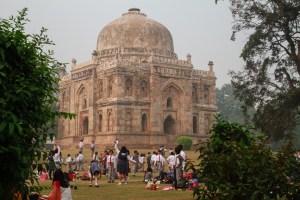
A high point of our entire trip was our first day in Delhi, when we visited the dargahs (tombs) of Sufi teachers Hazrat Inayat Khan and Pir Vilayat Inayat Khan. Finding the dargahs was a great introduction to the challenges of driving in Delhi (not that we had our hands on the wheel!): more cars than you can imagine, trucks, buses, motorbikes, bicycles, pedestrians, and more cows, most traveling on what seeed to us the wrong side of the road. It’s a cacophony of jostling and honking in what is apparently controlled chaos. On this day we had an English-speaking driver who didn’t speak English, and no guide, which was great: once we reached the dargahs, it allowed us plenty of time to sit alone quietly and meditate in that special atmosphere.
We stayed in GK2 (“Greater Kailash 2”) in the southern part of the city. We had a nice, modest hotel and found our way to a wonderful restaurant. (As far as we could tell from our brief and privileged visit, all Indian restaurants are wonderful.)
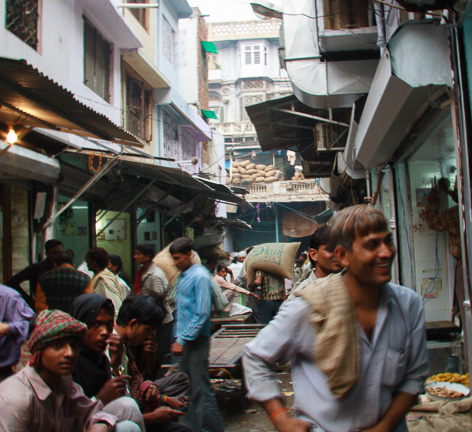
The following day, our guide Susil took us to some of the tourist highlights such as the Jama Masjid (“Friday Mosque”) and the Qutb Minar. We also prevailed upon him to take us to the Spice Market. We arrived there at rush hour, and we’re sure it’s the most crowded, busiest, liveliest, and – definitely – most aromatic place on Earth.
Agra (days 5-6)
We took the train to Agra. It was pretty nice: comfortable, not too crowded, and with full meals included.
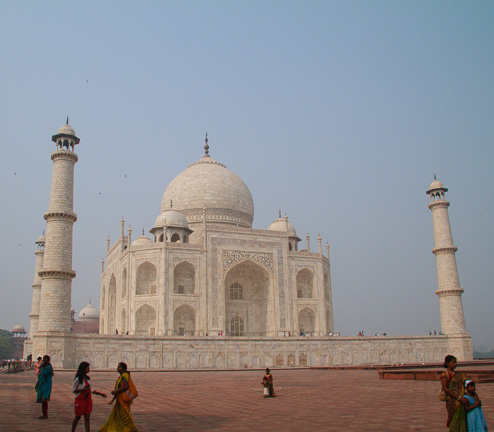
Of course we had sky-high expectations for the Taj Mahal, and we weren’t disappointed. The marble inlaid with jade, lapis lazuli, turquoise, carnelian, and jasper is gorgeous. Mike says it’s kind of a drag that we barely got to poke our noses into the inside of this vast and wondrous building. (Robin rolls her eyes: it’s a burial place. Plus we did get to go in a little bit.)
The Taj was built by the Mughal emperor Shah Jahan, who was also the author of the Jama Masjid in Delhi. Constructed beginning in 1632, the building is a mausoleum for Shah Jahan’s third wife, Mumtaz Mahal, who died bearing their 14th (!) child.
According to our guide, Shah Jahan intended to build a black Taj as his own mausoleum, in symmetrical position to the original across the Yamuna River. This seems to be a fiction, though – for instance, see this article on the Black Taj Mahal Myth.
Another attraction was the Agra Fort (or Agra “Red Fort”), which was particularly impressive because we didn’t have prior expectations and (according to Mike) because we were able to wander about inside. This building has a long and fascinating history. Shah Jahan was imprisoned here by his son Aurangzeb, supposedly because of his spendthrift ways (“Another Taj!? Enough is enough!”) A fight over succession seems more likely. The Agra Fort was also the home of the Koh-i-Noor diamond for a time.
While waiting in Agra for our train to Jhansi, we were approached on the platform by a large group of high school boys who had won a national science contest and were attending a conference with other winners. They were anxious to practice their English and talk politics. Completely delightful! From Jhansi we drove (yes, another amazing ride) to our first small-town stop: Orchha.
Orchha (days 6-7)
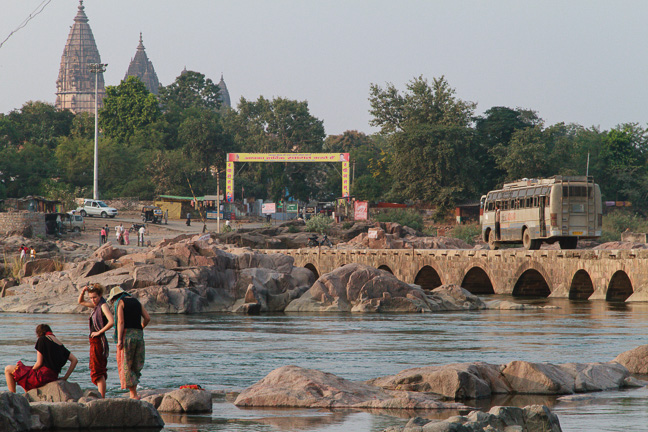
As you can see in the gallery, there are interesting things to see at Orchha, but the best part was the place we stayed, the Bhundelkhand Riverside, and its wonderful manager Ajay.
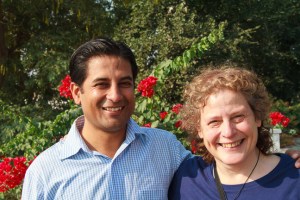
Ajay showed us terrific hospitality and spent a lot of time with us; he says he always “pounces” when he hears an American accent, and that certainly seemed to be the case with us. He also had a fascinating story to tell. The great-grandson of the last Maharaja of Orchha, he spent several years in the USA at school, and then as a Silicon Valley business development manager, before returning to Orchha to manage the hotel. “In America I was like a pillar growing ever thicker and stronger, but not supporting anything.” Spending time with him gave us an appreciation for the challenges of growing a business in modern India while meeting traditional responsibilities to the surrounding village and its families.
The Bundelkhand Riverside is surrounded by native jungle. We were lucky enough to see jackals from our balcony overlooking the river… apparently this is a rarity; Ajay said he had never seen them there.
Khajuraho (days 7-8)
As the only person in Asia who didn’t know what Khajuraho is famous for, Mike had a delightful “wtf!?” moment on first viewing the temple carvings. You can see in our gallery that many of the sumptuous and highly expressive carvings are also very explicitly sexual.
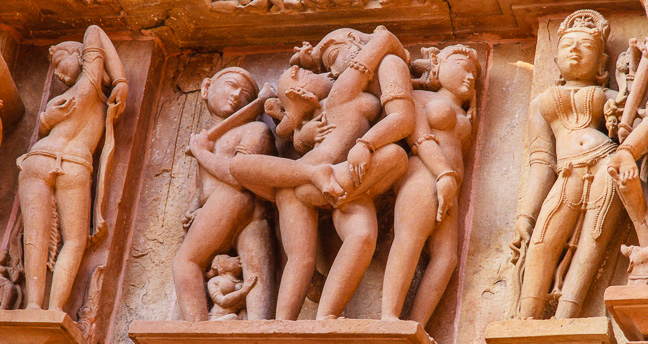
It was hard to figure out the relationship between the Khajuraho art and the generally modest Indian culture. Our guide and others relate it to Tantra, though we were also told that truly Tantric expressions of sexuality would always be concealed, never public. Again, we heard references to the Kama Sutra, but according to James McConnachie in The Book of Love: In Search of the Kamasutra, the relationship is not so simple:
Today, Khajuraho is popularly known as the ‘Kamasutra temple’, but its coupling statues do not in truth ‘illustrate’ Vatsyayana’s positions. They are the child of a strange union of Tantrism and fertility motifs, with a heavy dose of magic. Fertility and conception are of course screamingly absent from the resolutely secular Kamasutra – as is Tantrism.
With such disagreement among the experts, who are we to judge… though looking at some of these carvings we can’t help but think that if the goal was conception, there were easier ways to go about it.
Varanasi (days 8-10)
Our final stop in India: Varanasi, formerly Benares. According to Wikipedia, Varanasi is the oldest continously inhabited city in India and the holiest of the seven sacred pilgrimage cities for Hindus and Jains. Varanasi is also special to Buddhists because of nearby Sarnath, the deer park where Buddha taught his first disciples.
Varanasi was a perfect bookend to our first day in Delhi; likewise spiritually moving and another high point of the India portion of our trip.
We visited the ruins at Sarnath, as well as the nearby Mulagandhakuti Vihara temple and the small but exquisite Sarnath Museum, where photography was unfortunately not allowed. Among the museum’s many treasures is the Ashoka Pillar, whose crowning capital is the National Emblem of India: you can see its image on the flag and currency.
The heart of Varanasi (and, it could be said, of India) is Ganga – the Ganges River. Ganga is an epitome of India’s embrace of contradictions: polluted to a life-threatening degree, even carrying large quantities of human remains, yet the holiest place to bathe and a sacred place to die. We saw this inscription on a riverside wall: “Fortunate are the People Who Reside on the Banks of Ganga”.
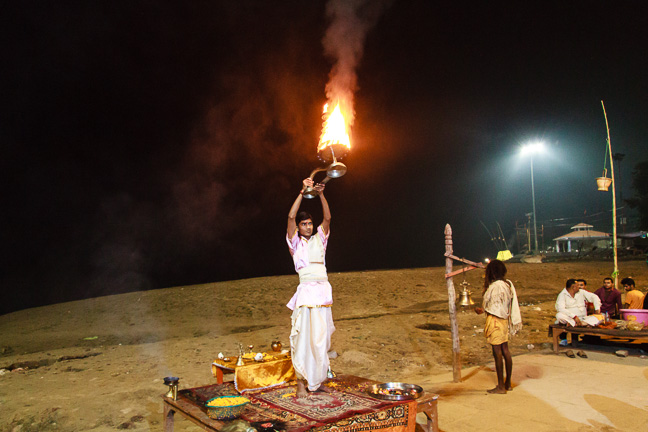
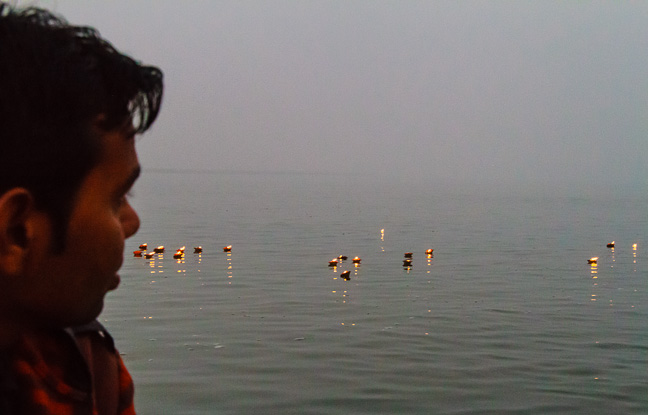
We walked along a few of the 84 ghats, took a sunrise boat ride up and down the shore, and twice attended evening Aarti: once at one of the larger ghats (Dr. Rajendra Prasad Ghat) and once at the small Assi Ghat, southernmost of all the Varanasi ghats, right in front of our riverside hotel. We found the Aarti ceremony very moving. The floating candles are surrounded by marigolds – we lit them and set them in the holy river. This beautiful video gives a fair sense of the Aarti experience, though you’ll have to imagine the pungence of the thick clouds of incense and the energy of thousands of pilgrims and worshippers: Varanasi Ganges River Ceremony Ganga Aarti. (This isn’t the real sound, though. The Aartis we attended sounded more like this.)
Did those of you familiar with the shofar enjoy the application of the conch in the Aarti? We were struck in particular by the almost verbatim analogues of teruah and tekiah gedolah…
More photos…
The complete gallery for this part of the trip is here: 2012 Asia part 1 – India.
 Mike and Robin's Photos