
The second leg of our 2012 Asia trip was Nepal. We spent 9 of 12 days trekking in the Annapurna Sanctuary region before departing for Bhutan, and also had a little time in Nepal’s two largest cities: Kathmandu and Pokhara.
Trekking in the Himalaya has been a lifelong dream, especially for Robin, and it didn’t disappoint! Of course the terrain was spectacular; we also had wonderful weather, met terrific people, and even ate some really good food – ask Robin about the “magic garlic soup”.
Photo gallery
The full photo gallery for our visit to Nepal is here: 2012 Asia part 2 – Nepal.
Kathmandu and Pokhara
We were in Kathmandu on days 10, 20, and 29 of our overall trip: the days before and after the trek, and the day after returning from Bhutan. The last of these days took us to Patan, the twin city just south of Kathmandu.
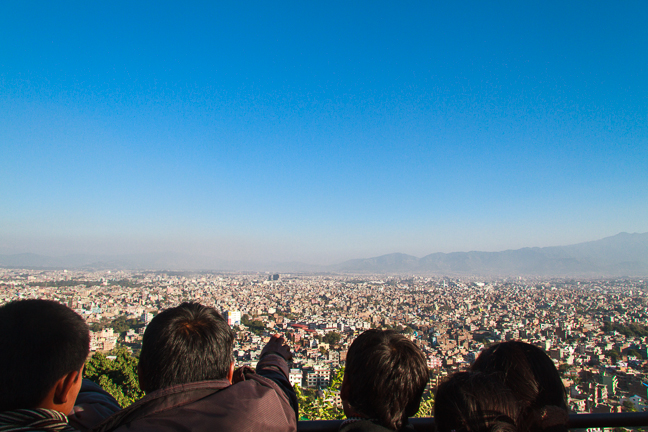
Because our time in Kathmandu was so broken up, we didn’t get as strong a sense of the city as we might have in three continuous days. But we did get to see some memorable things, and Crystal Mountain Treks treated us to lovely dinners on each night.
On arrival via Yeti Airlines, we were met by the extraordinary Kami, our guide for the duration in Nepal – you’ll hear more about him below. He took us to Pashupatinath Temple on the first day. This is a temple to Lord Pashupatinath: Nepal’s national deity, an aspect of Shiva.
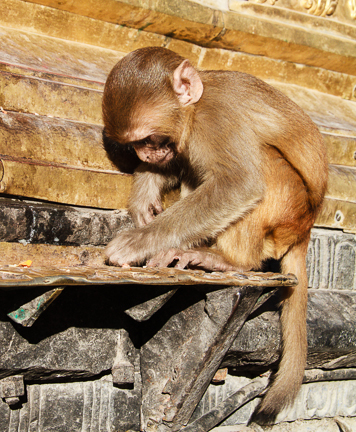 Later, after the trek, we took ourselves to Swayambhunath, the Buddhist “Monkey Temple”.
After coming down from the trek, we had part of a day in Pokhara, a city of about a quarter million that’s the gateway for Annapurna trekking. Our timing limited us to “tourist central”, but it was beautiful to walk (yes, walk!) along Phewa Lake and look up to where we’d been hiking. At dinner, we’re not sure what we had to eat, but we’ll always remember the Nepali language lesson we got from our sassy young server. “Dhanybhad bahini – thank you, sister!” (But she’d say “Dhanybhad didi” in return to Robin, the elder. Got it.)
“Zoun zoun!”
That’s Nepali for “hubba hubba”: let’s go!
What can we say about trekking? Just like backpacking at home, except… completely different. Longer (and higher) than anything we’d done before, and very grueling at times, but then a lodge at night with roof, mattress, and a restaurant. Plus a guide and a porter – we’ve never had that in the Olympics! 12-pound day packs definitely beat our usual backpacking rigs… note to selves: check out “ultralight packing”.
No doubt we could have done it on our own, but it was easier and infinitely more fun with the help of Kami, our guide, and “Carson”, our porter. (Kami is the one giving thumbs up in the photo.) Kami is a farmer most of the time; a trekking guide once or twice a year. Carson lives in Kathmandu.
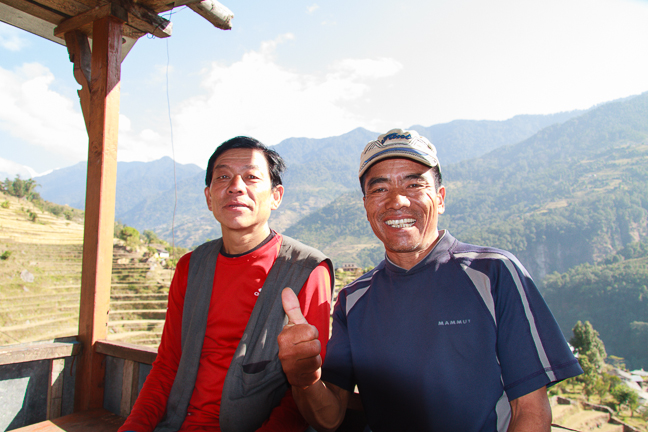
Their help with stuff and know-how was great, but who they are and their attitude about taking care of us was just awesome. Their sheer physical capacity is a marvel, too. Kami told us the standard load for a full-time Nepali porter is 100 kilos – 220 pounds – and these are not big people.
Robin was physically down on the first trekking day. Kami was probably a bit worried about her, though he didn’t let on until dinnertime. She wasn’t eating… not okay with Kami. She found the cure at lunch the second day: the aforementioned magic garlic soup. Just possibly the timing was favorable (she was already starting to feel better), but it was lovely medicine full of garlic and yellow-curry-type spices. She also said she thought she could manage some potatoes, so they brought her a plate of about twelve full-size baked russets. Too funny!
We had beautiful weather the entire time. In the lower elevations, temperatures were in the 70s. At the very top it got down to freezing, but we were well equipped – we never put on all the clothes we had. At night the lodge rooms, though unheated and uninsulated, retained quite a bit of warmth and kept us toasty.
Town and country
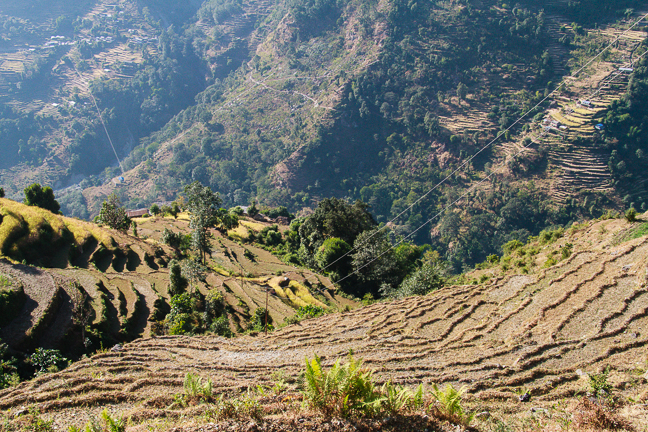
At first we were hiking through beautiful agricultural terrain, where the villages are permanently occupied by farmers. The Nepalis cultivate ground on such steep slopes that they have to be narrowly terraced by hand. They grow millet, buckwheat, rice, and lots of different cruciferous vegetables (cabbage, cauliflower, collards…)
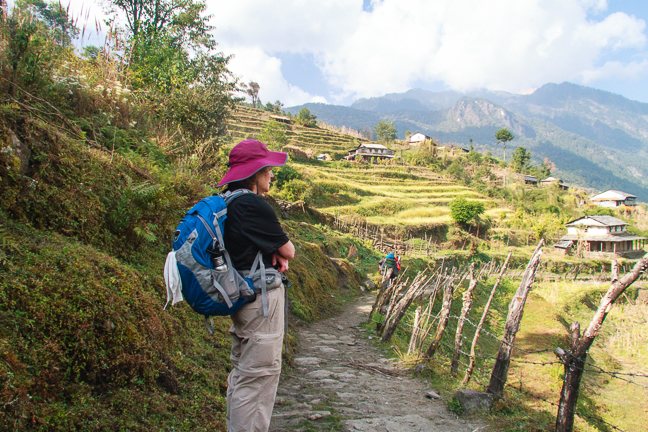
As you go higher, the conditions become more and more difficult for farming, until the plantings are hanging on for dear life to ground you wouldn’t think could possibly be worked.
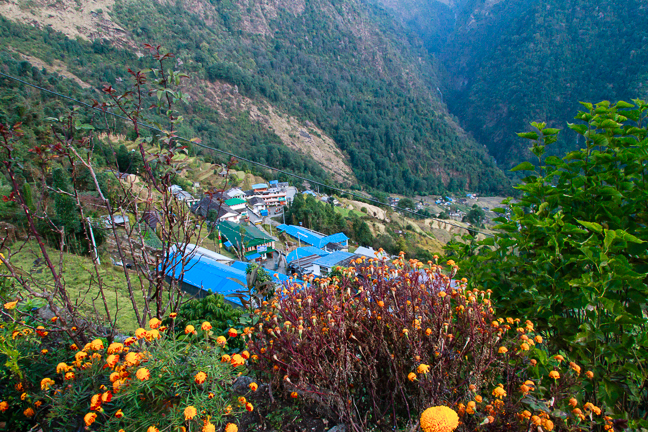
Finally, you’re in the Sanctuary itself, where you no longer see cultivation beyond small gardens, and the villages exist only to support trekking. There are signs in the Sanctuary warning that it’s forbidden to bring in or consume meat. There was some “punishable by” type wording: very cryptic – the best we could make of it was that violators’ souls will be in peril.
Children and Tihar
We saw children everywhere, especially because it was Tihar, the Nepali equivalent of Diwali.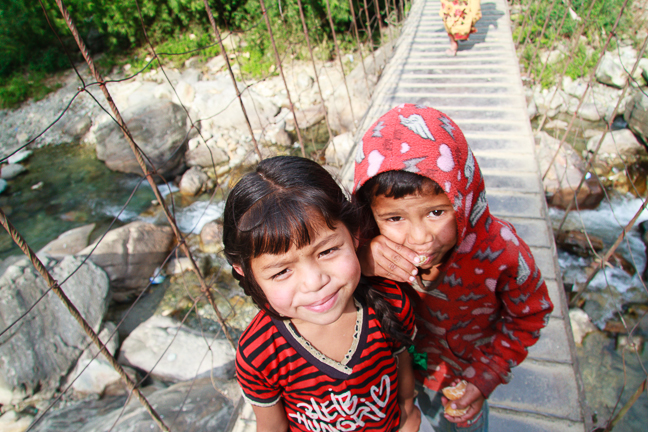 The children gather on the path and sing a special song while holding out a plate for money or treats. We had been repeatedly schooled that we must not give to begging children (it supports exploitation), but we learned that this was more of a Halloween trick-or-treat equivalent. That was a relief, because saying “no” to these delightful kids was painful!
Tihar also brought singers and dancers to our lodges for a few nights, making for even more of a party atmosphere than usual.
The people in the villages were very focused on supporting their schools. We saw lots of donation boxes, and several people talked to us about the importance and difficulty of keeping the schools open. Robin, with her professional knowledge of what’s really important, had brought a bag of erasers that was received with great ceremony by one of the villagers.
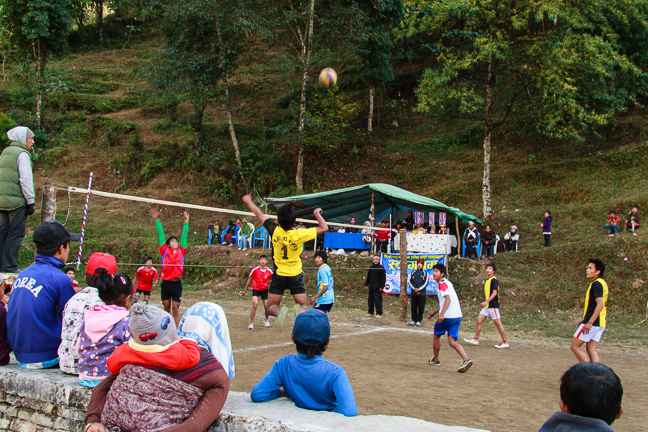
We even ran into a volleyball game right on the trail that turned out to be a fund-raiser for the schools. We don’t know who the teams were, but the players must have come from far and wide – the level of play was very good: long volleys of dig, set, smash all the way.
“Tea Houses”
Each afternoon brought us to a “tea house” lodge (and each lunch, and each time we got too tired to take another step, for that matter). With a few adaptations they’re pretty much the same from the lowest to highest elevations.

Your room is a stone and wood box with a mattress on a bench: very simple, but very welcome!
There’s always a restaurant. The dal bhat – lentils, rice, vegetable, greens, “pickle” – is always good, and bottomless, which matters when you’re trekking. It’s also right up our vegetarian alley – we love this food. But it gets old every meal, so then there’s the menu, which is an amazingly diverse multi-page affair with everything from pizza to chow mein. Mike says, “Probably no Michelin star in the foreseeable future, but they do incredibly well under the circumstances.” Robin thinks that’s harsh and says the food was fabulous!
We fell in love with the people at the lodges. Very comfortable and friendly with the trekkers, very fun. The language barrier generally ranged between significant and complete, but that just made communicating more fun.
On top
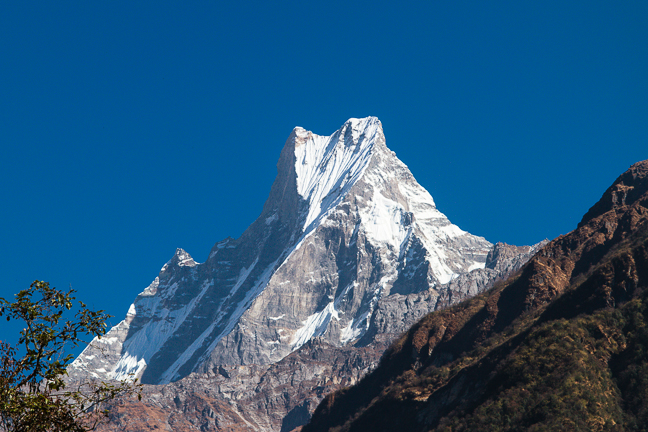
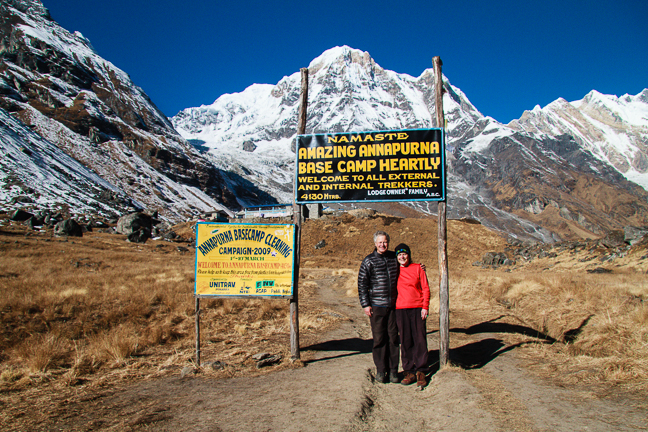
Annapurna Base Camp, or “ABC”, was our highest point: 262 meters lower than the summit of Mount Rainier. It was a splendid day, and we felt good.
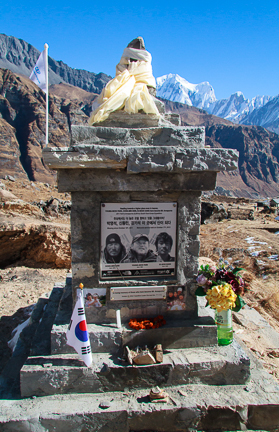
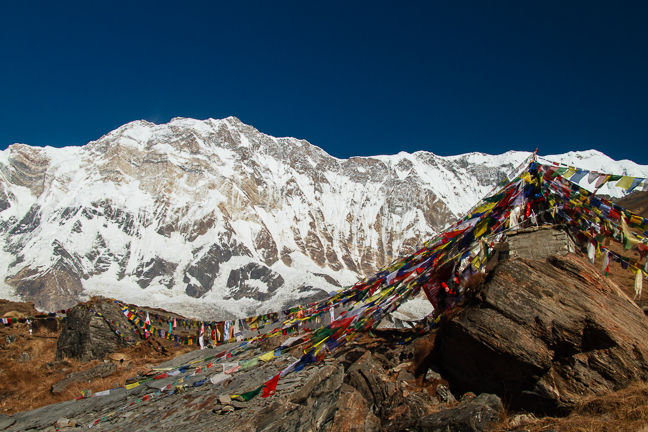
The area of the camp is full of prayer flags and monuments to fallen climbers.
 According to Wikipedia’s Annapurna article:
The Annapurna peaks are among the world’s most dangerous mountains to climb, although in more recent history, using figures from only 1990 and after, Kangchenjunga has a higher fatality rate. As of the end of 2009, there had been 157 summit ascents of Annapurna I, and 60 climbing fatalities on the mountain. This fatality-to-summit ratio (38%) is the highest of any of the eight-thousanders. In particular, the ascent via the south face is considered, by some, the most difficult of all climbs.
Fellow trekkers
We were traveling with people from all over the world, and because we were on the same paths with kinda similar paces, we ran into the same people over and over. Given the activity and the setting, most were friendly and fun.
Here are Josh and Annalee, from England. 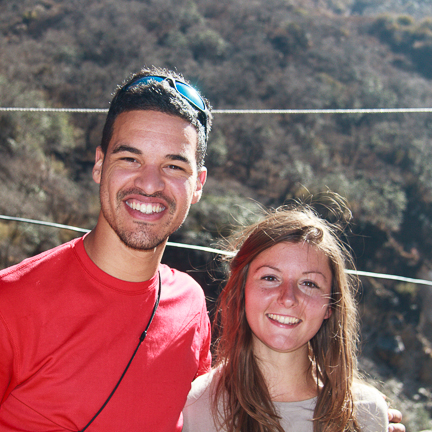 Robin met Annalee descending from Ghandruk, nervously eyeing a cow on the steps below. It turned out that Annalee had been gored by a cow in India! The trek was throwing this girl some curve balls – she was also developing plantar fasciitis (we guess) in her foot. Kami had a huge stash of pharmaceuticals, and Robin knew what to do with them; together they were able to help somewhat.
We admired Annalee’s determination, and Josh was taking great care of her. Robin commented that she thought they should consider each other “keepers”, and guess what? When we encountered them again as we were just descending from ABC and they were about to reach it, Annalee showed us her beautiful new engagement ring!
More photos…
The complete gallery for this part of our trip is here: 2012 Asia part 2 – Nepal.
 Mike and Robin's Photos